
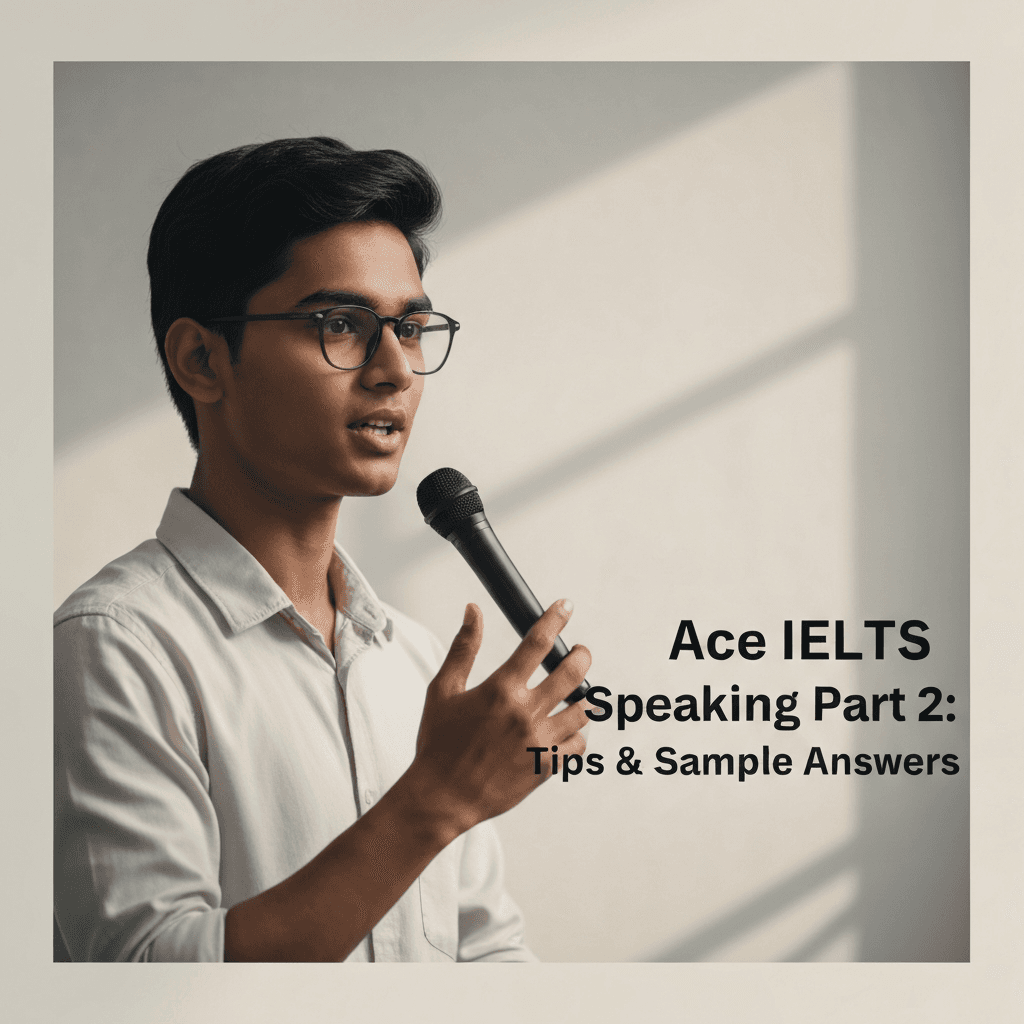
Unlock Your Potential: Mastering IELTS Speaking Part 2
The IELTS Speaking Part 2, also known as the 'cue card' or 'long turn,' can feel daunting. You're given a topic, a minute to prepare, and then you must speak for two minutes. But with the right strategies and a clear understanding of what the examiner is looking for, you can not only survive but thrive! This comprehensive guide will break down the examiner's expectations, the key criteria used to assess your performance, and provide practical tips and sample answers to help you achieve your desired score in the IELTS speaking test.
Understanding the Examiner's Perspective
It’s crucial to understand that the examiner isn’t just listening to your vocabulary and grammar; they’re assessing your ability to communicate effectively. They want to see if you can organize your thoughts coherently, speak fluently (without excessive pauses or hesitations), use a range of language accurately, and address the prompt fully. Think of it as a mini-presentation. You need a clear structure, engaging content, and confident delivery.
Key Assessment Criteria
The examiner uses four main criteria to assess your performance in the IELTS Speaking test. Understanding these is vital for effective preparation:
- Fluency and Coherence: This refers to your ability to speak smoothly and connect your ideas logically. Are you able to speak at a reasonable pace without excessive hesitations? Does your response flow well, with clear connections between sentences and ideas?
- Lexical Resource: This assesses your vocabulary range and accuracy. Do you use a variety of words and phrases appropriately? Can you paraphrase effectively and avoid overly simple language?
- Grammatical Range and Accuracy: This looks at your ability to use a range of grammatical structures correctly. Are you making frequent grammatical errors, or are you demonstrating a solid command of English grammar?
- Pronunciation: This refers to how clear and understandable your speech is. Are you pronouncing words correctly? Are you using intonation effectively to convey meaning?
Practical Tips for IELTS Speaking Part 2 Success
1. The One-Minute Prep Time: Use it Wisely!
Don't waste your preparation minute! Quickly jot down keywords and a basic structure. Think about:
- Introduction: A brief opening statement related to the topic.
- Main Points: 2-3 key aspects you want to discuss.
- Examples: Specific examples to support your points.
- Conclusion: A brief summary or final thought.
Avoid writing full sentences. Focus on keywords that will trigger your memory during the long turn.
2. Structure is Key: Follow a Logical Flow
A well-structured answer is easier to follow and demonstrates coherence. Consider using a simple structure like:
- Introduction: Briefly introduce the topic.
- Point 1: Explain your first point and provide an example.
- Point 2: Explain your second point and provide an example.
- Point 3 (Optional): If time allows, add a third point.
- Conclusion: Summarize your thoughts or offer a final reflection.
3. Expand and Elaborate: Don't Just List
Don't just provide a list of points. Explain each point in detail and provide specific examples. The examiner wants to see that you can develop your ideas and express them clearly. For instance, instead of saying "I like reading," say "I enjoy reading because it allows me to escape into different worlds and learn about new cultures. For example, I recently read a novel set in Japan, and it sparked my interest in Japanese history and traditions."
4. Use a Range of Vocabulary and Grammar
Show off your English skills! Use a variety of vocabulary and grammatical structures. Don't be afraid to use more complex language, but make sure it's accurate. Practice using synonyms and paraphrasing to avoid repetition. For instance, instead of repeatedly using the word "good," try using words like "excellent," "fantastic," "wonderful," or "remarkable."
5. Speak Fluently and Naturally
Try to speak at a natural pace and avoid excessive pauses or hesitations. It's okay to pause briefly to think, but try to fill the gaps with filler words like "um," "er," or "well." Practice speaking regularly to improve your fluency and confidence. Record yourself and listen back to identify areas for improvement.
Sample Answers and Analysis
Let's look at a sample IELTS Speaking Part 2 question and a model answer:
Cue Card: Describe a time when you received good news.
- What the news was
- Who gave you the news
- Why it was important to you
- How you felt when you received it
Model Answer:
"I'd like to talk about the time I received news that I had been accepted into my dream university. I remember it vividly. It was a Tuesday afternoon, and I was nervously checking my email every few minutes. Finally, I saw an email from the university admissions office. My hands were shaking as I opened it. The email began with 'Congratulations!' and went on to confirm my acceptance into the program I had been hoping for.
The person who gave me the news, indirectly of course, was the admissions officer who sent the email. But behind that, it was the culmination of efforts from my teachers, my family, and myself.
This news was incredibly important to me because getting into this particular university was a long-held goal. It was a highly competitive program, and I had put in a lot of effort to prepare for the entrance exams and interviews. Being accepted meant that all my hard work had paid off, and it opened up a pathway to my future career aspirations. I knew that this university would provide me with the best possible education and opportunities to succeed.
When I received the news, I was overwhelmed with joy and relief. I immediately called my parents to share the good news, and we celebrated that evening with a special dinner. It was a moment I will never forget, and it motivated me to work even harder to make the most of my university experience. The feeling of accomplishment and excitement was truly unforgettable."
Analysis of the Sample Answer
- Fluency and Coherence: The answer flows smoothly and logically. The speaker uses clear connectors like "I remember it vividly," "Finally," and "When I received the news" to guide the listener.
- Lexical Resource: The speaker uses a range of vocabulary, including phrases like "dream university," "admissions office," "long-held goal," and "overwhelmed with joy."
- Grammatical Range and Accuracy: The speaker uses a variety of grammatical structures correctly, including simple, compound, and complex sentences.
- Pronunciation: The answer assumes clear and understandable pronunciation. Practice is key to achieving this!
Final Thoughts
IELTS Speaking Part 2 requires practice, preparation, and a clear understanding of what the examiner is looking for. By following these tips and studying sample answers, you can improve your fluency, vocabulary, grammar, and pronunciation, and ultimately achieve your desired score. Remember to stay calm, speak confidently, and engage with the topic. Good luck!